
Related: commercial plumbing & water service · gas fitting · MA backflow testing rules · request a quote
Project at a glance
- Property: Commercial building, Worcester area, MA
- Goal: Protect the public water supply from backflow without shutting the building down for every test
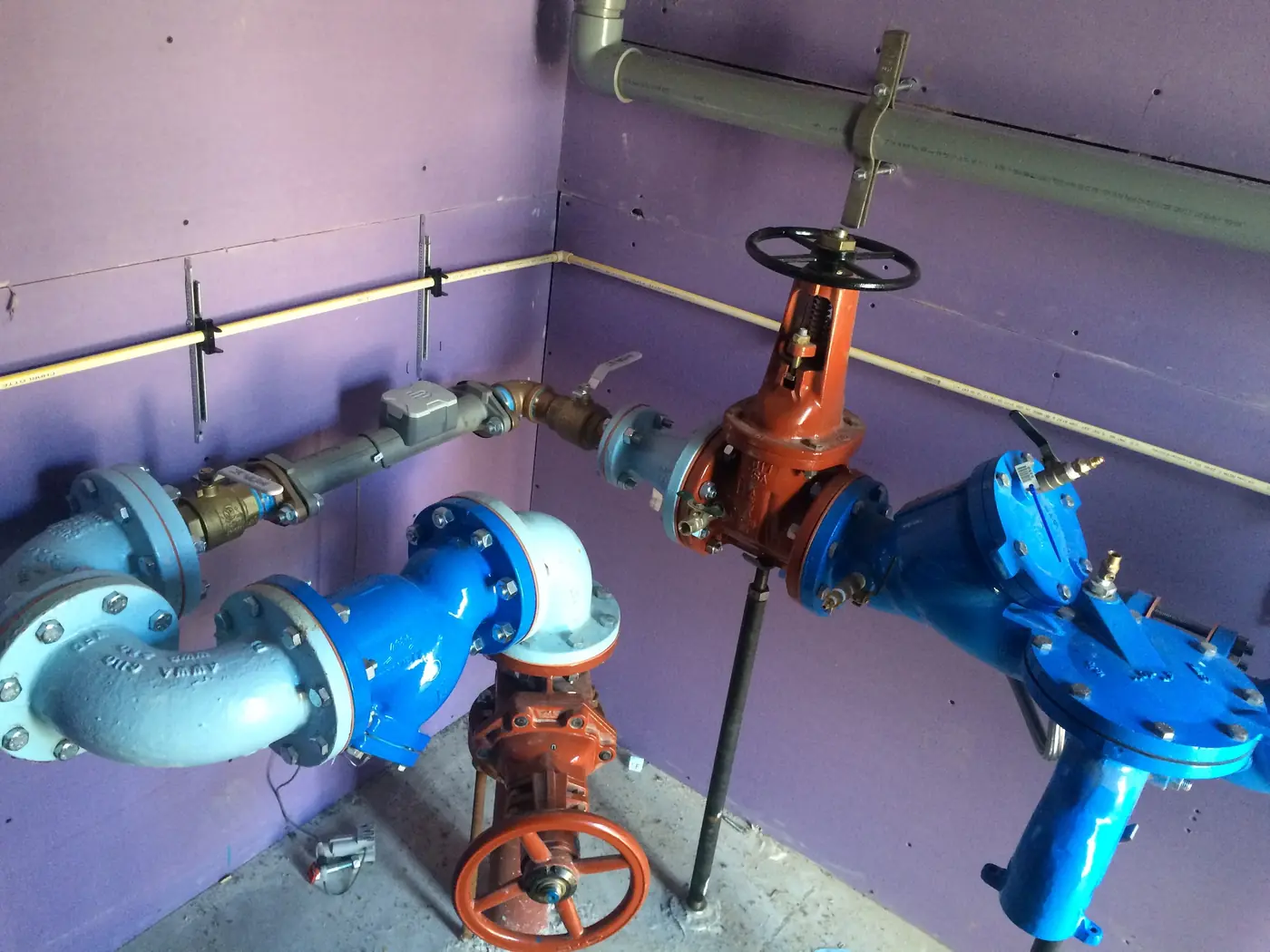
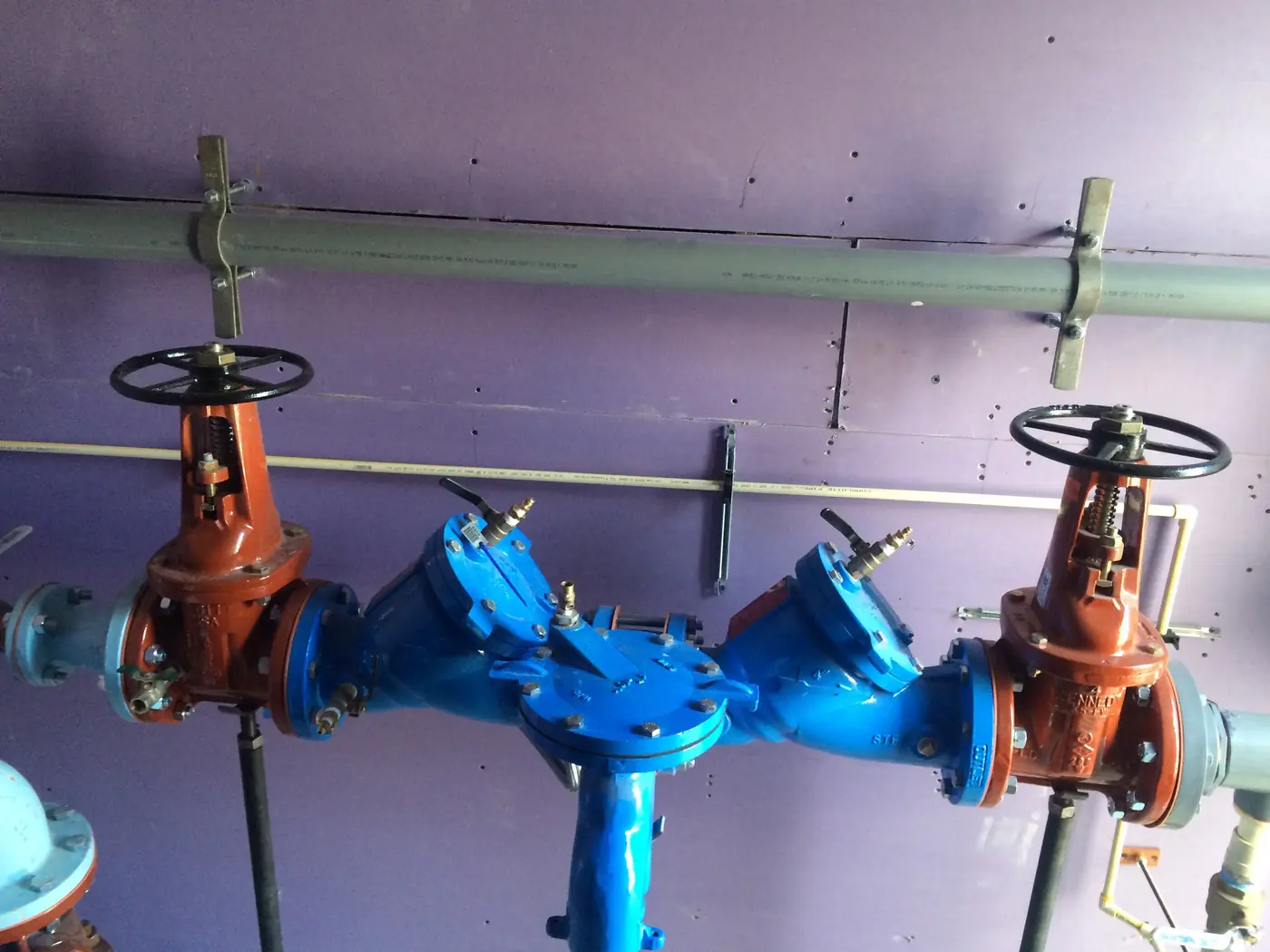
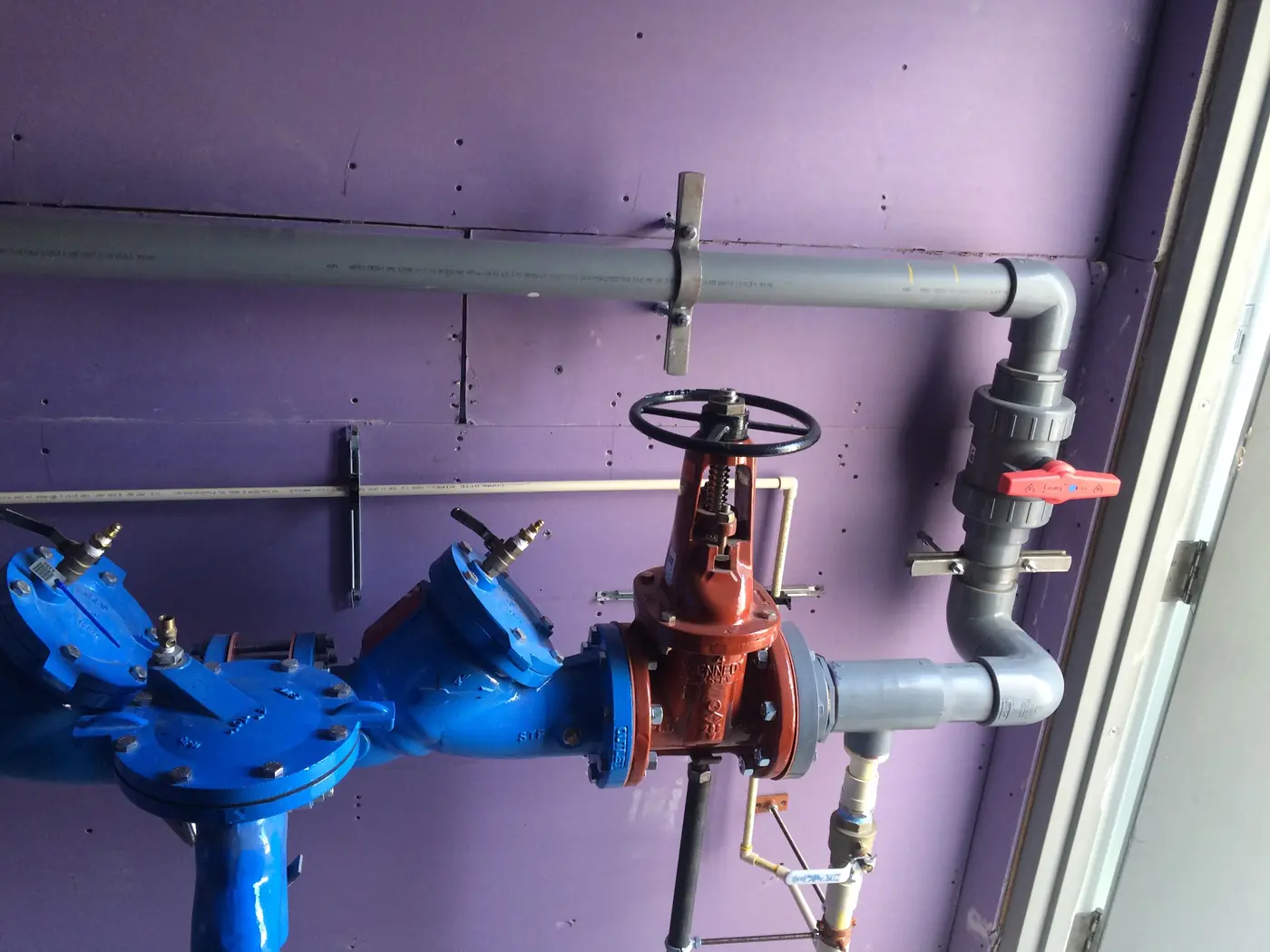
- Installed: Two backflow preventer assemblies in parallel on the incoming service, each isolated by its own OS&Y gate valves
- Access: Test cocks and relief port left clear so future testing needs no dismantling
- Outcome: Installation pressure-tested and proper operation confirmed
Every commercial building has a point where the town's water becomes the building's water. A backflow preventer sits at that point, and its job is simple to state and important to get right: water is allowed to flow in, and it is never allowed to flow back out. Without one, a drop in street pressure — a hydrant opening, a main break, a big draw somewhere down the line — can pull whatever is inside the building's plumbing back into the public supply.
Why two assemblies instead of one
The detail worth noticing here is that there are two assemblies, piped in parallel, each with its own shutoff valves. That's not redundancy for its own sake. Backflow devices have to be tested periodically by a certified tester, and testing means taking the device out of service. On a single-device installation, that test shuts the building's water off.
With a parallel arrangement, one side is isolated and tested while the other carries the building. For anything that can't simply close for the afternoon — a school, a restaurant kitchen, a medical or lab space, a building with tenants — that layout is the difference between routine maintenance and a disruption.
What the job actually involves
- Sizing the assembly to the building — a backflow preventer creates pressure loss by design. Size it too small and fixtures on the top floor suffer; size it correctly and nobody ever notices it's there.
- Choosing the right device type for the hazard the building presents — the degree of protection required depends on what's connected downstream, not on the size of the pipe.
- Laying out the room so the device has clearance above and below, the test cocks are reachable, and the relief port has somewhere to discharge.
- Support and alignment — a cast-iron and flanged assembly is heavy. It gets supported properly rather than hanging on the pipe it's connected to.
- Permit, testing and paperwork — the installation is permitted, the devices are tested at start-up by a certified tester, and the results go to the water department.
What building owners should know
In Massachusetts, cross-connection control is regulated by MassDEP, and enforcement runs through your local water department. Two things follow from that, and they catch owners out regularly:
- The testing is recurring, not one-time. Your water department sets the schedule and expects the test results on file. Missed tests are the most common violation notice we see.
- The device has to stay accessible. Backflow assemblies get built around, boxed in, or buried behind storage over the years. When the tester can't reach it, the test can't happen — and the fix is usually more expensive than leaving the clearance alone would have been.
If you own or manage a commercial property and you're not sure when your device was last tested — or whether the water department has a current record for it — that's worth checking before you get a letter about it.
Our role
- Assessed the incoming service and the protection the building required.
- Installed parallel backflow preventer assemblies with full isolation valving.
- Supported and aligned the assemblies, keeping test cocks and relief clear.
- Tied the assemblies into the building's distribution piping.
- Pressure-tested the installation and confirmed proper operation.
- Left the room laid out so future testing and service is straightforward.
IS Plumbing LLC works on commercial as well as residential systems — water services, backflow protection, gas fitting and heating — across Worcester County, MetroWest and Greater Boston, MA. If you need a backflow preventer installed, replaced or brought back into compliance, get in touch or call +1 (774) 486-0909.