
See a real job: parallel backflow preventers on a commercial water service →
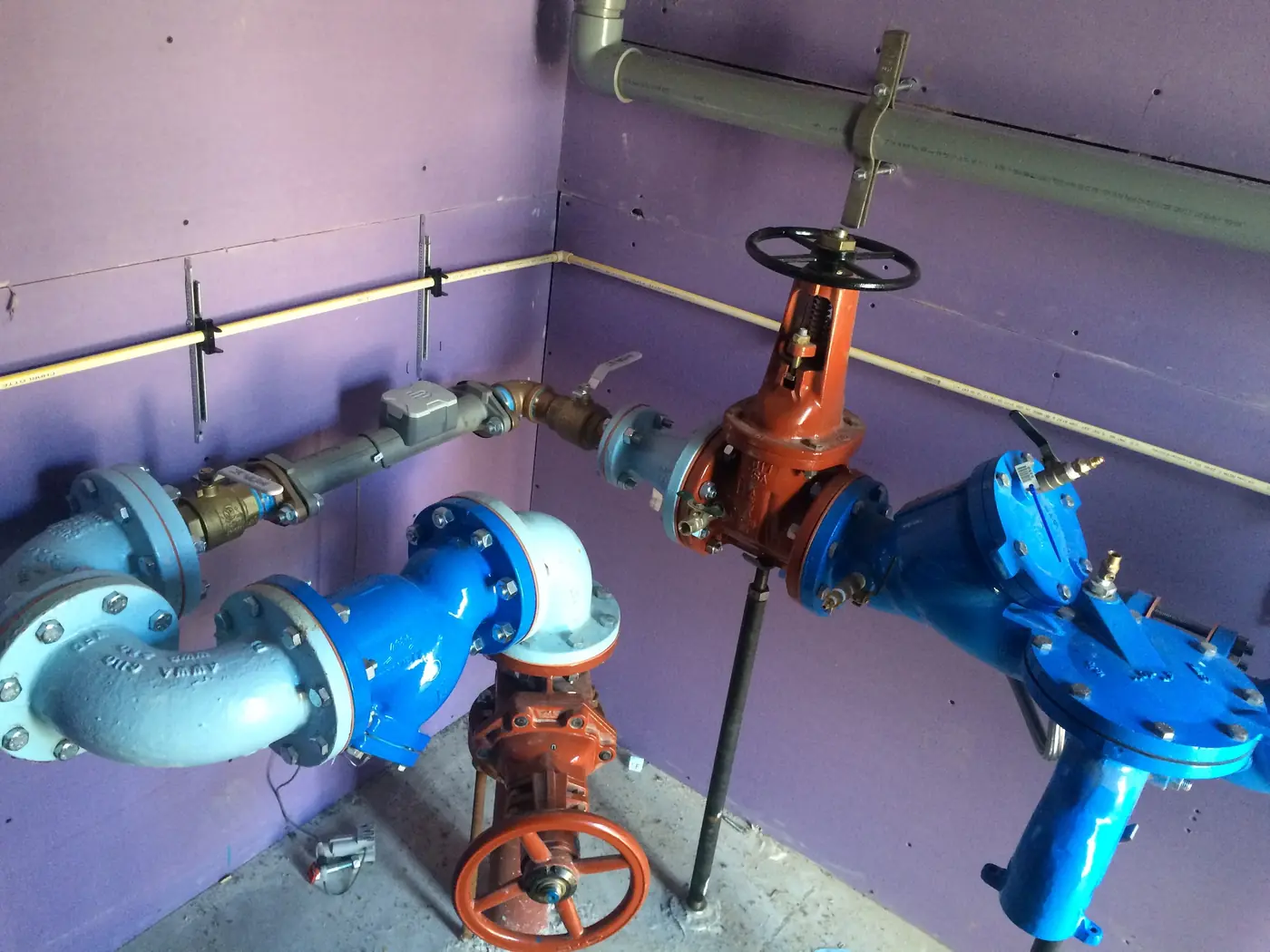
In Massachusetts, reduced-pressure backflow preventers (RPZs) must be tested twice a year and double check valve assemblies once a year, by a state-certified backflow tester. That's set by the state drinking water regulations at 310 CMR 22.22, and enforced by your local water department. If you own or manage a commercial, institutional or multi-family building, chances are you have at least one of these devices — and the responsibility for keeping it tested sits with you.
What a backflow preventer does
Normally water flows one way: from the street main into your building. Backflow is when it reverses. It happens in two ways — back-siphonage, when pressure in the main drops (a hydrant opens, a main breaks) and pulls water backwards, and back-pressure, when a pump, boiler or other equipment in the building pushes water back out. Either way, whatever is in your piping — boiler chemicals, fire-sprinkler water that's sat for years, lawn fertilizer, process water — can end up in the public supply. A backflow preventer is a mechanical one-way gate at the point where your plumbing connects to something that could contaminate it.
The common device types
- Reduced pressure backflow preventer (RPZ or RP) — the highest level of protection, used where the hazard is a health hazard. It has a relief valve that dumps water if the checks fail, so it needs somewhere to drain.
- Double check valve assembly (DCVA) — two check valves in series, for lower-hazard connections such as many fire sprinkler systems.
- Pressure vacuum breaker (PVB) — common on lawn irrigation systems where back-pressure isn't possible.
- Atmospheric vacuum breaker (AVB) — a simpler device for low-hazard uses with no back-pressure.
Which one you need depends on the hazard downstream, not on the size of the pipe. That call is made during the design review — more on that below.
How often backflow devices must be tested
Under 310 CMR 22.22(13)(d):
- RPZ devices: tested semiannually — twice a year. If the water supply is used less than six months a year (a seasonal building, for example), once a year. Routine RPZ tests can't be done within five months of each other without approval.
- Double check valve assemblies: tested annually.
- Pressure vacuum breakers: the regulation says they should be tested at least annually by the owner.
Your water system can require more frequent testing, and it can inspect and test devices at any time. Each test has to be done by a Massachusetts Certified Backflow Prevention Device Tester, who files the report with the water supplier and the owner within 30 days.
If a device fails its test
A failed device must be overhauled, repaired or replaced and retested within 14 calendar days. Repairs and installations must be done by a Massachusetts licensed plumber (fire protection systems go to a licensed sprinkler contractor). Common failures are worn check-valve seats and rubber parts, debris lodged in a check after main work in the street, and relief valves that discharge constantly. The regulation also expects owners of RPZs and double checks to keep a spare-parts kit and the special tools on hand, so a repair doesn't wait on parts.
Installing a new device: approvals first
A new RPZ or double check isn't something you just install and test. Under 310 CMR 22.22:
- A design data sheet and plans are reviewed by a certified cross-connection surveyor and approved by the water system (or MassDEP) before installation.
- The plumbing permit can't be issued until it's accompanied by that approval letter.
- Within 14 days of installation, the owner notifies the water system to arrange inspection, and the device is tested for proper operation.
- The owner registers the device with the water system.
Lower-hazard devices like PVBs and AVBs are approved through the local plumbing permit alone.
What owners are responsible for
- Making sure each device is tested on schedule — the water system may test it, require you to hire a certified tester, or use a contractor; ask yours which.
- Keeping the device accessible. A device that's been boxed in, built around or buried behind storage can't be tested.
- Keeping records: device records for the life of the device and test reports for seven years.
- Giving the water system 30 days' written notice before taking a device out of service or before a change of ownership.
The consequences are real. The water supplier can shut off service for failure to test or maintain a device, and the regulation allows penalties of up to $25,000 per day. In practice, the first sign of trouble is usually a violation letter — and the most common one is simply a missed test.
Homeowners: lawn irrigation and winter
Most homes don't have a testable device on the domestic water service, but many have one on the lawn sprinkler system, usually a PVB on the outside wall. Two things matter in the fall. First, if your water department asks for annual test results, schedule the test before the system is shut down. Second, the device must be drained for winter — a PVB left full of water will crack in the first hard freeze, and it's one of the most common spring repair calls we get. (While you're at it, see our tips on keeping pipes from freezing.)
Where a parallel install helps
Testing takes a device out of service. On a building with one device, that means the water's off during the test. For schools, restaurants, medical offices and tenanted buildings, we often install two assemblies in parallel with their own shutoffs, so one carries the building while the other is tested or repaired. That's what we did in this commercial backflow case study.
Frequently asked questions
How often does a backflow preventer need to be tested in Massachusetts?
Under 310 CMR 22.22, reduced-pressure (RPZ) backflow preventers must be tested twice a year (once a year if the supply is used less than six months a year), and double check valve assemblies once a year. Pressure vacuum breakers should be tested at least annually. Your water system can require more frequent testing.
Who can test a backflow preventer in Massachusetts?
Only a Massachusetts Certified Backflow Prevention Device Tester. The tester sends the results to the water supplier and the owner within 30 days. Repairs and installations must be done by a Massachusetts licensed plumber, or a licensed sprinkler contractor for fire protection systems.
What happens if my backflow preventer fails the test?
It must be overhauled, repaired or replaced and retested within 14 calendar days. Owners of RPZ and double check devices are expected to keep a spare parts kit on hand so repairs aren't delayed.
What happens if I don't test my backflow device?
The water supplier can shut off water service for failure to test or maintain a backflow device, and 310 CMR 22.22 allows penalties of up to $25,000 per day. Most owners first receive a violation notice from the water department.
Do I need approval to install a backflow preventer in Massachusetts?
For an RPZ or double check valve assembly, yes: the design must be approved by the water system or MassDEP before the plumbing permit is issued, the water system inspects the installation, and the device is registered. Pressure and atmospheric vacuum breakers are approved through the local plumbing permit.
Need a backflow preventer installed, repaired or replaced after a failed test? We work on commercial and residential water services across Greater Boston, MetroWest and Worcester County.