
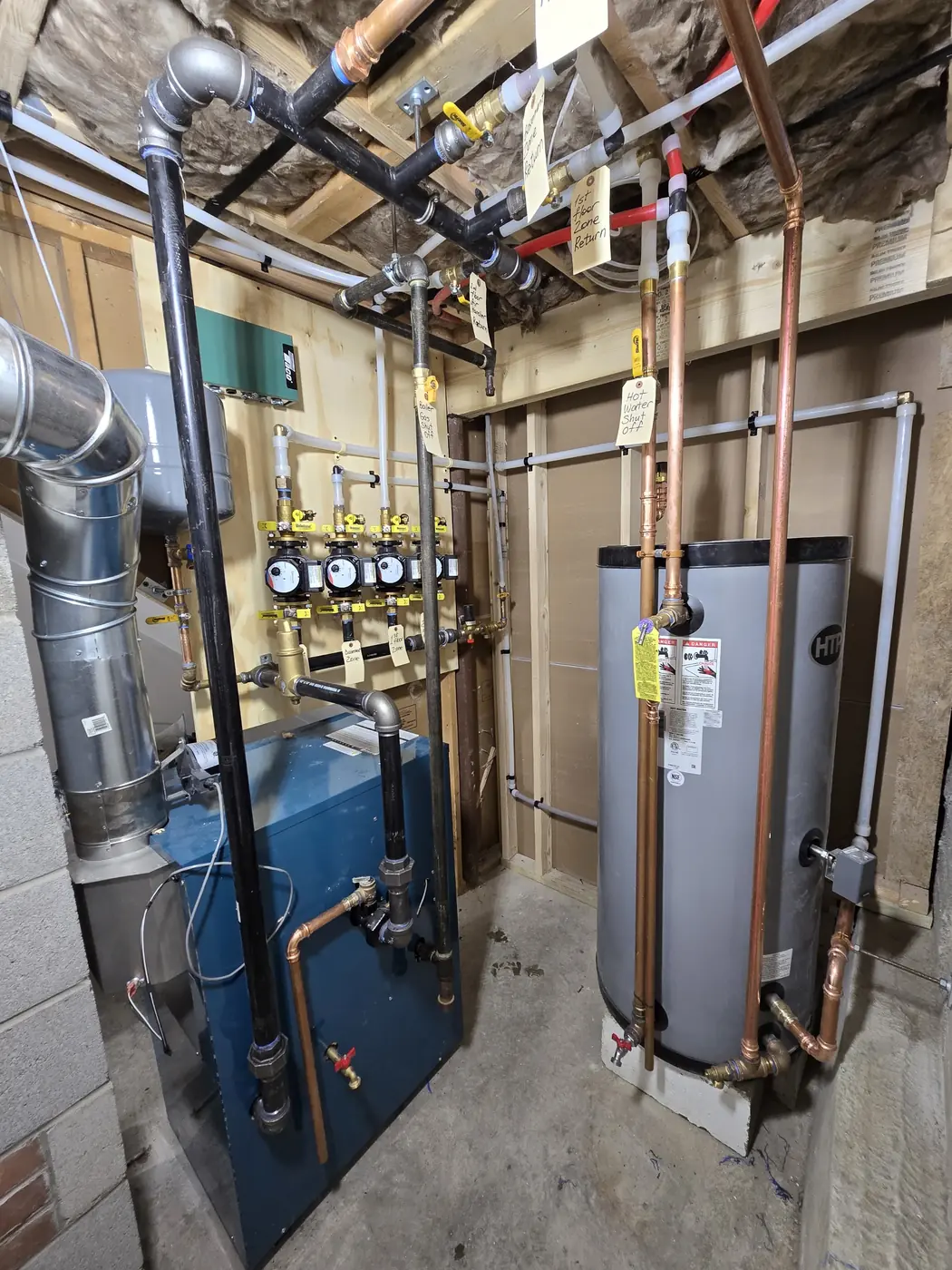
If your boiler isn't heating, check the thermostat, the boiler's emergency switch and breaker, the pressure gauge, your fuel supply, and the outdoor vent before you call anyone. Those five things account for a large share of the no-heat calls we answer across Greater Boston every fall. None of the checks below involve opening the boiler or touching gas or oil components — they're the same things I'd look at in the first ten minutes of a service call, and they're safe for any homeowner to do.
Skip the checklist if you smell gas, your carbon monoxide alarm is sounding, or there's water pouring from the boiler. Get out and call from outside — see what to do if you smell gas — then call us on the 24/7 emergency line.
1. The thermostat
It sounds too simple, but start here. Make sure it's set to Heat (not Cool or Off), the setpoint is a few degrees above the current room temperature, and the display is on. Battery-powered thermostats go blank or stop calling for heat when the batteries die — swap them before anything else. On a smart thermostat, check that a schedule or "away" mode isn't holding the temperature down.
2. The emergency switch and the breaker
Most Massachusetts homes have a boiler emergency shutoff switch — usually a light-switch-style toggle with a red cover plate, at the top of the basement stairs or at the boiler-room door. It looks exactly like a light switch, and it gets flipped off by accident more often than you'd think. Make sure it's on. Then check the circuit breaker or fuse for the boiler in your electrical panel. If a breaker trips again right after you reset it, leave it off and call — that's an electrical fault, not a nuisance trip.
3. The pressure gauge
Hot-water (hydronic) boilers have a combination pressure and temperature gauge on the front or top. A typical residential system sits around 12–15 psi when cold and rises somewhat as it heats up. Two readings matter:
- Too low (under about 10 psi): the system may have lost water through a leak or a dripping relief valve, and many boilers will lock out to protect themselves. Don't keep refilling it — a system that keeps losing pressure has a leak that needs finding.
- Near 30 psi: that's where the relief valve on most residential boilers opens. High pressure usually points to a failed expansion tank or a fill valve that won't shut off. Call — don't try to bleed it down yourself on a hot system.
Steam boilers work differently: check the sight glass. If you can't see water in it, the boiler is low on water and should be shut off until it's been looked at.
4. Your fuel supply
Oil: read the gauge on top of the tank. Running out is common in the first cold snap, and an oil burner that ran dry often needs its line bled before it'll restart — even after the delivery. Gas: check whether your other gas appliances (stove, water heater, dryer) are working. If none of them are, the problem is upstream of the boiler — call your gas utility. Propane: check the tank percentage.
5. Error codes — and the one-reset rule
Modern boilers show an error or lockout code on the display. Write it down and look it up in the manual (or take a photo of the display) — it tells your plumber exactly where to start. Pressing reset once is fine. If it locks out again, stop.
This matters most on oil burners. The red reset button on the burner's primary control is not a "try again" button: every press can pump unburned oil into the combustion chamber, and repeated resets can lead to a dangerous puff-back or flooding. One press, then call.
6. The outdoor vent and intake (high-efficiency boilers)
If you have a high-efficiency condensing boiler — the kind with white PVC pipes going out the side of the house — go outside and look at those pipes. Snow drifts, leaves, a wasp nest or ice can block the intake or exhaust, and the boiler will shut itself down. Clear anything blocking them by hand. Also look at the small condensate line near the boiler: if it's clogged or frozen, many condensing boilers will refuse to fire. (More on how these boilers work in why a condensing boiler pays for itself.)
7. Some rooms cold, others fine
If the boiler is running but some radiators or zones stay cold, the issue is usually distribution, not the boiler:
- Air in the system. Gurgling and cold tops on upstairs radiators are the classic sign. Cast-iron radiators have a small bleed valve — open it a quarter turn with a radiator key over a cup until water (not air) comes out, then close it. Recheck the pressure gauge afterwards; bleeding lowers it.
- A zone thermostat or zone valve. If one floor is cold, check that floor's thermostat first. A stuck zone valve or a failed circulator pump is a service call.
- Closed valves. Make sure no one closed a radiator valve over the summer.
8. Keep the pipes safe while you wait
If the heat's going to be off for a while in freezing weather, protect the plumbing: open the cabinet doors under sinks on outside walls, let a faucet drip, and keep a space heater (safely placed) in the coldest room. Our guide on keeping pipes from freezing covers the rest. A no-heat call is an inconvenience; a burst pipe on top of it is a much bigger bill.
When to stop and call
Call a licensed plumber or heating technician if any of these are true:
- You smell gas, oil or exhaust, or a carbon monoxide alarm goes off (Massachusetts law — "Nicole's Law" — requires CO alarms in homes with fossil-fuel equipment; make sure yours work).
- The boiler locks out again after a single reset.
- The pressure keeps dropping, or the relief valve is dripping or discharging.
- You hear banging, kettling or loud rumbling from the boiler.
- There's water on the floor around the boiler or water heater.
- You've worked through the list and still have no heat.
When you call, tell us the boiler make, the error code if there is one, the pressure reading, and what you've already checked. It shortens the visit.
The best fix is a fall tune-up
Most of the boilers we see fail on the first cold night are ones that haven't been serviced in a few years. An annual cleaning and inspection in September or October — burner, ignition, flue, safety controls, expansion tank, relief valve — catches the parts that are about to fail while it's still warm outside. If your boiler is old enough that repairs keep stacking up, it may be time to look at boiler replacement.
Frequently asked questions
Why is my boiler on but not heating the house?
If the boiler is running but radiators stay cold, the usual causes are air trapped in the system, a stuck zone valve, a failed circulator pump, or low system pressure. Bleed upstairs radiators, check the pressure gauge (about 12–15 psi cold is typical), and check each zone's thermostat. If radiators are still cold, call a heating technician.
What pressure should my boiler be at?
Most residential hot-water boilers run around 12–15 psi when cold and somewhat higher when hot. Under about 10 psi the boiler may lock out; near 30 psi the relief valve will open. Both ends mean something needs attention. Steam boilers are different — check the water level in the sight glass instead.
How many times can I press the reset button on my boiler?
Once. If the boiler locks out again, stop and call. On oil burners especially, repeated resets can pump unburned oil into the combustion chamber and cause a puff-back.
Why does my boiler turn off when it snows?
High-efficiency condensing boilers vent through PVC pipes on the outside wall. Snow, ice or debris over the intake or exhaust will make the boiler shut down for safety. Clear the pipes by hand and keep that area free of drifts all winter.
Is no heat a plumbing emergency?
It can be. In freezing weather, a home without heat risks frozen and burst pipes within hours, and any gas smell, carbon monoxide alarm or leaking boiler is an emergency. IS Plumbing answers 24/7 across Greater Boston, MetroWest and Worcester County.
Still no heat after the checklist? We fix and replace boilers across Greater Boston, MetroWest and Worcester County.