
Pressure gauge at 30 psi or water coming out of the relief valve? Skip ahead to high pressure: what it means →
Every November we get the same two calls from homes with hot-water heat: "the radiators upstairs are cold at the top" and "the boiler gauge is reading something weird." Both usually have simple explanations. Air gets into a heating system over the summer, and the pressure gauge is the easiest way to tell whether the system has the right amount of water in it. This guide walks through bleeding radiators and baseboard heat, what the pressure gauge should read, and when a reading means something is wrong.
If the boiler isn't running at all, start with our 8 boiler checks for no heat. This article is about a boiler that runs but doesn't heat the whole house evenly.
First: is it hot water or steam?
Older Massachusetts homes have both, and the advice is different. Look at the boiler and the radiators:
- Hot water (hydronic): a round pressure and temperature gauge reading in psi, usually with a scale up to 30 or 75. Radiators or baseboard have a small square or slotted bleed valve near the top, and there are pipes going both into and out of each radiator. Most homes built or remodeled since the 1960s, and every baseboard system, are hot water.
- Steam: a glass tube on the side of the boiler with water visible inside it (the sight glass), and a pressure gauge with a very low scale, often 0 to 3 or 0 to 5 psi. Radiators have a chrome or brass vent sticking out of one side, and often only one pipe. Steam is common in older homes in Newton, Brookline, Cambridge and Boston.
The bleeding and pressure steps below are for hot water. Steam has its own section further down.
Signs there's air in a hot-water system
- Radiators that are hot at the bottom and cold at the top.
- Gurgling, trickling or "running water" sounds in the pipes when the circulator pump starts.
- An upstairs zone or the top floor that heats slower than the rest of the house.
- A baseboard loop that is warm at the start and cold at the end.
Air builds up after the system sits all summer, after any repair that drained part of the system, and in homes where the water keeps getting topped up because of a small leak.
How to bleed a radiator, step by step
You need a radiator key (a few dollars at any hardware store; some valves take a flat screwdriver instead), a cup or small container, and a rag.
- Turn the thermostat down and give the system 20 to 30 minutes. Air rises to the top of a radiator when the water is still, and you won't be dealing with near-boiling water.
- Start at the top of the house, or with the radiator furthest from the boiler on that floor. Air ends up at the highest points first.
- Hold the rag and cup under the bleed valve and open it a quarter to a half turn. You'll hear a hiss as the air comes out.
- Close it as soon as water comes out in a steady stream with no sputtering. Don't open the valve all the way. The small screw can come out completely, and then you have a stream of hot water and a tiny part to find on the floor.
- Work through the rest of the radiators floor by floor, going down.
- Go back to the boiler and read the pressure gauge. Every radiator you bleed lets out a little water and lowers the pressure. If it's now below about 12 psi cold, the system needs more water (see below).
- Turn the heat back up and feel the tops of the radiators after an hour. If one is still cold at the top, bleed it again the next day.
Baseboard heat with no bleed valves
Most fin-tube baseboard doesn't have a bleed valve on each section. Some have a small air vent at the end of a run, under the cover. Many don't, and air is cleared by purging the loop at the boiler: the zone is isolated with a valve, a hose is put on a purge valve (a small drain valve) on the return pipe, and fresh water is pushed through the loop until no more air comes out.
On a well-labeled system that's a 15-minute job. On an unlabeled one, opening the wrong valve can overpressure the boiler or drain a zone. If you've never done it, ask us to purge the zones during a service visit and show you which valves are which.
What the boiler pressure gauge should read
On most homes with a hot-water boiler, the gauge works like this:
- Cold system: about 12 to 15 psi. That's enough to push water to the top floor of a typical two- or three-story house. Taller buildings need more, so some systems are set a little higher on purpose.
- Hot system: a few psi higher. Water expands when it heats up, and the expansion tank absorbs most of that. A rise from 12 cold to around 18 to 22 hot is normal.
- Below about 10 psi: too little water. Upstairs radiators go cold, and many modern boilers lock out with a low-pressure error.
- Close to 30 psi: too much. That's where the relief valve on most residential boilers is set to open.
Most gauges show both pressure and temperature on one dial. Make sure you're reading the right needle or scale.
If the pressure is low
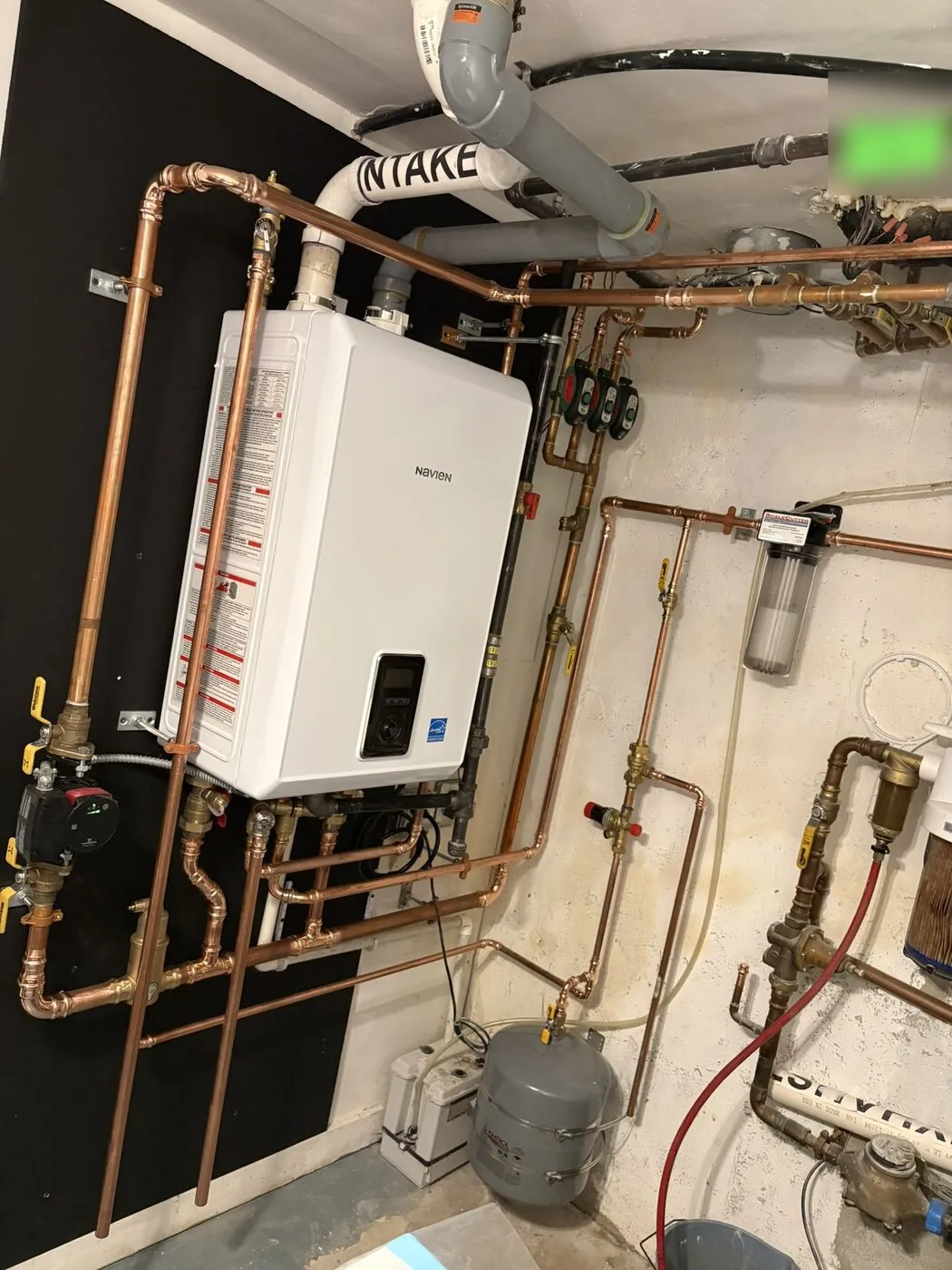
Most systems refill automatically through a fill valve (also called a pressure-reducing or feed valve) on the cold water line going into the boiler. It's usually brass with a small lever on top. If the pressure is low after bleeding, it often comes back up by itself within a few minutes. If it doesn't, lifting the lever on many fill valves sends water in faster. Watch the gauge, let go at about 12 to 15 psi cold, and don't leave it.
Some systems, especially newer boilers and wall-hung combis, have a manual fill instead. Follow the boiler manual, or ask us to show you on the next service visit.
One top-up is normal. Regular top-ups are not. A sealed heating system should hold its water for years. If you're adding water every week or two, it's going out somewhere: a dripping relief valve, a weeping radiator valve, or a leak under a floor. Fresh water brings in new oxygen and minerals each time, which corrodes cast iron radiators and the boiler's heat exchanger from the inside.
If the pressure is high, or the relief valve drips
A gauge climbing toward 30 psi, or water dripping from the pipe that runs down from the relief valve, almost always means one of two things:
- The expansion tank has failed. It's the small tank, usually gray, white or blue, near the boiler. Inside there's a rubber diaphragm with an air cushion on one side. When the diaphragm fails, the tank fills with water, there's nowhere for the expanding water to go, and the pressure spikes every time the boiler heats up. On older systems with a large steel tank up in the basement ceiling, the tank can slowly fill with water and cause the same problem.
- The fill valve is letting water through when it shouldn't, so the system slowly overfills. In that case the pressure is high even when the boiler is cold.
Don't cap, plug or tie off a relief valve, even if it drips. It's the part that keeps the boiler from building up dangerous pressure. Don't try to bleed pressure off a hot system yourself either. Turn the thermostat down, put a bucket under the relief pipe, and call. Replacing an expansion tank or a fill valve is a common, quick repair.
Steam heat: don't bleed it, check the vents
Steam radiators work differently. When the boiler fires, steam pushes air out of each radiator through the vent on its side, and the vent closes once steam reaches it. There's nothing to bleed.
- A radiator stays cold: the vent is often stuck shut, clogged or painted over. Replacement vents are inexpensive, but only change them on a cold system.
- A vent spits water or hisses constantly: it's failed open and needs replacing.
- Banging and knocking (water hammer) usually means water is pooling where it shouldn't. On a one-pipe system, the radiator should tilt slightly toward the valve so condensed water can run back to the boiler. The valve should also be all the way open or all the way closed, never halfway.
- Check the sight glass. With the boiler cold, the water should be roughly half to two-thirds of the way up the glass. If you can't see water in it, don't add water to a hot boiler. Turn the boiler off and call.
- Steam pressure is low by design. Most homes run at well under 2 psi. A steam gauge reading anything like 12 to 15 psi means something is wrong. Shut the boiler down and call.
Many steam boilers also have a low-water cutoff that the manufacturer says to flush (blow down) regularly during the heating season. If you aren't sure whether yours needs it or how to do it, ask during your annual service.
When bleeding doesn't fix it
If the air keeps coming back, or a zone stays cold with no air in it, the problem is somewhere else in the system: a circulator pump that has stopped, a stuck zone valve, an air separator or automatic air vent at the boiler that has failed, sludge in old radiators, or a system that was never balanced after a boiler replacement. Those are service calls. We see a lot of this after boiler swaps, when a new high-efficiency boiler was connected to an old system without proper air removal and flushing.
Frequently asked questions
What should my boiler pressure be?
On most homes with a hot-water (hydronic) boiler, about 12 to 15 psi when the system is cold. It normally rises a few psi as the water heats up, often into the high teens or low 20s. If it climbs toward 30 psi, where the relief valve on most residential boilers opens, or drops below about 10 psi, something needs attention.
Why are my radiators cold at the top and warm at the bottom?
That is almost always air trapped in the radiator. Air collects at the highest point, so the top stays cold while hot water circulates below it. Bleeding the radiator with a radiator key until water comes out, then checking the boiler pressure, usually fixes it.
Do I bleed radiators with the heat on or off?
Let the system cool down first, or at least turn the thermostat down and wait 20 to 30 minutes. Air separates and rises when the water is still, and the water that comes out of a cooler radiator is less likely to scald you. Then turn the heat back up and check the pressure gauge.
Should I bleed steam radiators?
No. Steam radiators don't have a bleed valve; they have an automatic air vent on the side that lets air out as the steam comes in. If a steam radiator stays cold, the vent may be stuck or painted over, or the radiator may be pitched the wrong way. Don't open or remove a vent on a hot steam system.
Why does my boiler pressure keep dropping?
Water is leaving the system somewhere: a dripping relief valve, a leaking radiator valve or baseboard joint, a weeping fitting near the boiler, or a leak you can't see under a floor. Bleeding radiators also drops the pressure a little. Topping it up once is fine. If you have to keep refilling it, call, because fresh water brought in over and over corrodes the boiler from the inside.
When to call a plumber
Call if the pressure keeps dropping and you keep refilling, if the gauge climbs toward 30 psi or the relief valve drips, if a zone stays cold after bleeding, or if you have steam heat and the water level, pressure or banging don't look right. We service and replace boilers, expansion tanks, fill valves, circulators and zone valves across Greater Boston and MetroWest. See our boiler and water heater services, or call the 24/7 emergency line if you have no heat in freezing weather.
Pressure that won't stay put, a dripping relief valve, or rooms that stay cold? Call, or request a quote for a boiler service.