
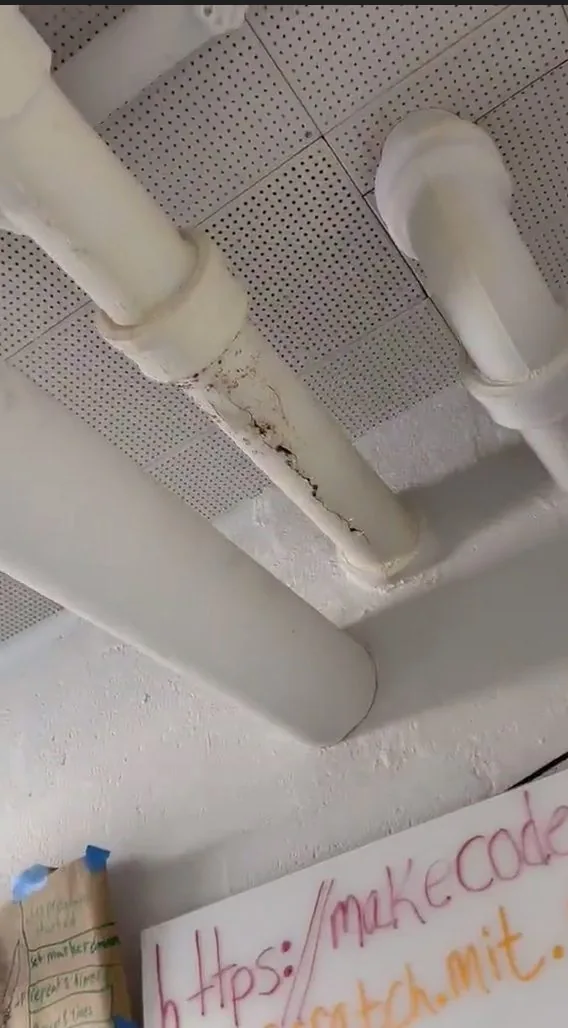
Cast iron drain and sewer pipe is still in place in a lot of older Massachusetts homes, and much of it is still working. When it does fail, the warning signs are rust stains and weeping at the joints, cracks, sewer smells, slow drains that keep coming back, and water stains on ceilings under bathrooms. A single failed section can usually be cut out and replaced. If the camera shows the pipe is deteriorating along its whole length, replacing the line is the better fix.
Sewage leaking into the house — from a ceiling, a wall or a pipe in the basement — is a health hazard, not a wait-and-see problem. Stop using the fixtures that drain through that line and call our 24/7 emergency line.
1. Rust stains and weeping at the joints
Look along the exposed pipe in your basement. Orange or brown streaks, white mineral crust, or damp spots at the hubs (the joints) mean water is getting through. On old lead-and-oakum joints, a slow weep is often the first sign.
2. Visible cracks or a rotted-out bottom
Cast iron corrodes from the inside. In horizontal runs, the bottom of the pipe — where the water sits — can thin out until it cracks or rots through along its length, even while the outside still looks solid. Vertical cracks also show up on stacks, often near supports or where the pipe passes through a floor.
3. Sewer smell
A sewer smell in the basement or a bathroom with no obvious cause can mean a crack or a failed joint is letting sewer gas out. (It can also be a dried-out floor drain trap — pour a gallon of water into floor drains you rarely use and see if the smell goes away.)
4. Slow drains and clogs that keep coming back
As cast iron ages, rust and scale build up on the inside wall and narrow the pipe. Waste catches on the rough surface, so clogs come back a few weeks after every cleaning. If you've had the same line snaked more than once in a year, it's time to look inside it.
5. Water stains on the ceiling below a bathroom
A brown stain on the ceiling under a bathroom that grows when someone showers or flushes is often a drain leak, not a supply leak. Cast iron stacks and branch lines inside walls and ceilings are common culprits in older multi-story homes.
6. Wet spots, sinkholes or lush grass over the sewer line
Outside, a buried cast iron building sewer that has cracked or separated can leak into the soil. Watch for a soggy patch, a dip in the lawn, or a strip of unusually green grass between the house and the street.
What makes cast iron fail
Age is the big one: decades of waste water and sewer gas corrode the pipe from the inside. But how it was installed matters too. On a recent emergency call at a school in the Worcester area, a cast iron sewer pipe at the ceiling had cracked and was leaking into an occupied building. Part of the cause was the support: the pipe was clamped rigidly to the structure. Buildings move slightly with temperature and settling, and cast iron is strong but brittle. When that movement goes straight into the pipe, it cracks. We isolated the damaged section and replaced it without interrupting the school day.
See the real job: emergency cast iron sewer repair in an occupied school →
Confirm it with a camera first
Before deciding anything, have the line inspected with a sewer camera. It shows whether you're looking at one cracked section or pipe that's scaled, flaking and thin along its whole length. That's the difference between a repair and a replacement. It also catches roots, offsets and bellies in the buried line. Camera inspection is part of our sewer and drain service.
Repair a section or replace the line?
- Section repair makes sense when the damage is local: one cracked length, one failed joint, one rotted horizontal run. The bad section is cut out and replaced with new pipe joined by shielded no-hub couplings, and it's supported so that the building's normal movement doesn't crack the new piece the same way.
- Replacement makes sense when the camera shows deterioration everywhere, when you've already had several section repairs, or when the walls are already open anyway.
- Pipe lining is an option for some buried lines that are structurally sound enough to line. Not every pipe is a candidate — ask after the camera inspection.
New drain piping can be PVC or new cast iron, depending on the building and what the plumbing code requires. Cast iron is quieter, which matters on stacks running through living spaces. Drain replacement is permitted work in Massachusetts and must be done by a licensed plumber.
A renovation is the best time to do it
If you're remodeling a bathroom or kitchen in an older home, look at the cast iron while the walls are open. Replacing an old stack or branch line during rough-in costs a fraction of tearing out new tile later to fix a leak behind it. In a recent Boston apartment renovation we replaced every water and gas line from rough-in to final inspection. See also why your remodel should be permitted.
Cast iron is a drain problem. If you're seeing rusty water, low pressure or pinhole leaks on the supply side, that's a different set of pipes. See 7 signs your home may need repiping.
Frequently asked questions
How long do cast iron drain pipes last?
Cast iron drain pipe often lasts many decades, and plenty of older Massachusetts homes still drain through their original cast iron. Condition matters more than age: a camera inspection shows whether the pipe is still sound or has corroded and scaled inside.
Can you replace just part of a cast iron drain pipe?
Yes. If the damage is local, the failed section is cut out and replaced with new pipe joined by shielded no-hub couplings. If the pipe is deteriorating along its whole length, replacing the line is usually the better long-term fix.
Should cast iron be replaced with PVC?
It depends on the building and the plumbing code. PVC is common in homes and is lighter and less expensive. Cast iron is quieter, which matters on stacks that run through living spaces, and it is required in some buildings. A licensed plumber will choose the material the code requires.
What are the signs of a failing cast iron sewer pipe?
Rust stains or weeping at the joints, visible cracks, sewer smell, slow drains and clogs that keep coming back, water stains on ceilings below bathrooms, and wet spots or depressions in the yard over the sewer line.
Is a leaking cast iron sewer pipe an emergency?
If sewage is leaking into the building, yes. It creates a health hazard and causes water damage and mold. Stop using the fixtures that drain through that line and call a plumber. IS Plumbing answers 24/7 across Greater Boston, MetroWest and Worcester County.
Worried about old cast iron? We inspect, repair and replace drain and sewer lines across Greater Boston, MetroWest and Worcester County.