
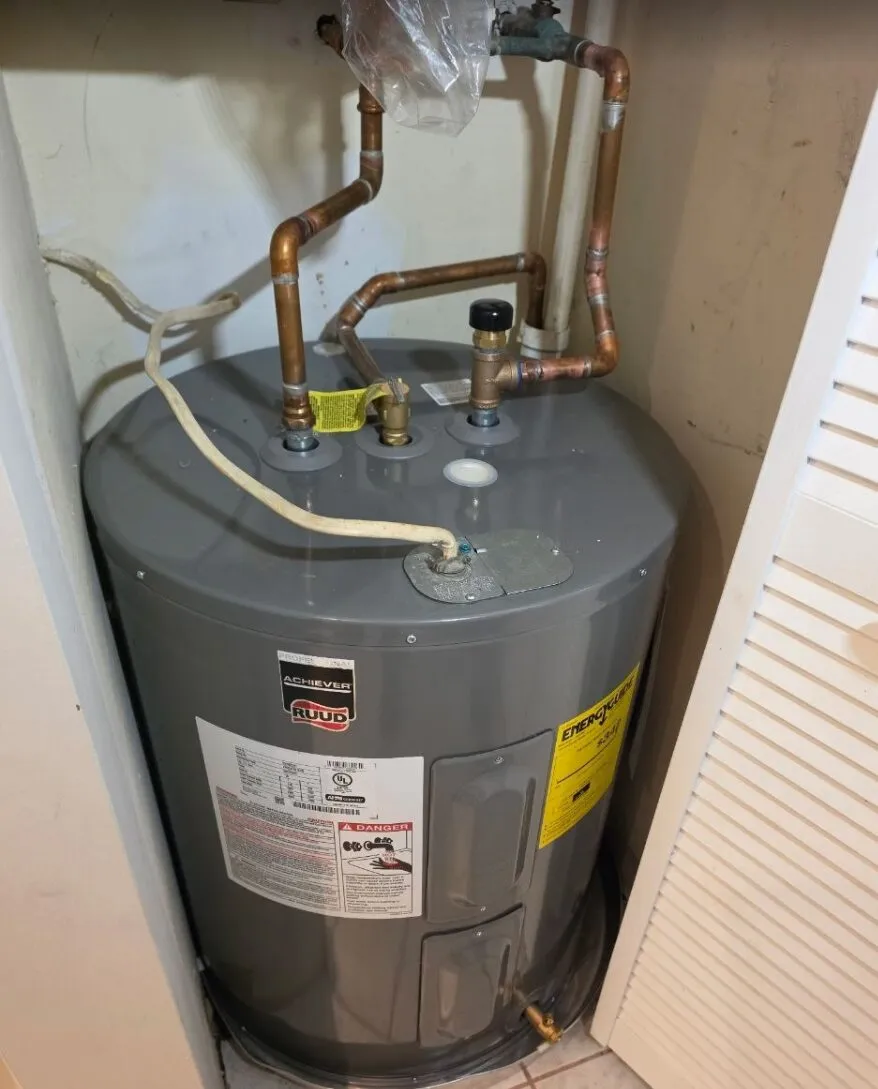
If your water heater is leaking, turn off its power or gas, close the cold-water valve on top of the tank, and then find where the water is coming from. Leaks from the pipe connections, the drain valve or the relief valve can usually be repaired. Water coming from the tank itself, out from under the jacket at the bottom, means the inner tank has rusted through. A tank can't be patched, so it has to be replaced, and it should be done soon, because a small weep can turn into a full tank on the floor without warning.
Treat it as an emergency if water is spreading toward an electrical panel or outlets, the floor is flooding faster than you can mop, or you smell gas. Stay out of standing water near electrical equipment, and call our 24/7 emergency line. If you smell gas, leave first and follow these steps.
Step 1: Shut it down safely
- Electric water heater: switch off its breaker in the electrical panel. Don't stand in water to do it. If the panel is in the wet area, call us first.
- Gas water heater: turn the gas control knob on the front of the tank to Off or Pilot. You don't need to shut the gas to the whole house.
- Close the cold-water supply valve on the pipe going into the top of the tank (the cold side). That stops the tank from refilling as it leaks. If that valve won't turn or won't hold, close your main water shutoff.
Be careful around the tank: the water inside can be hot enough to scald even after the heat is off, and the relief valve pipe can discharge without warning.
Step 2: Find where the water is coming from
Dry everything off with a towel, then watch for a few minutes. Where the water reappears tells you most of what you need to know:
- Pipe connections on top. Drips from the hot and cold fittings, or from corroded dielectric unions, are common and usually repairable. Look for white or green crust on the fittings.
- The temperature & pressure (T&P) relief valve. That's the valve on the side or top with a pipe running down toward the floor. A valve that drips or discharges is doing its job: something is making the pressure or temperature too high. Common causes are thermal expansion with no expansion tank (or a failed one), high street pressure, or a thermostat set too high. Sometimes the valve itself is worn. Don't cap or plug the discharge pipe — that valve is what keeps a tank from failing violently.
- The drain valve at the bottom. A drip from the spigot-style valve near the floor is often just a valve that isn't fully closed or has a worn washer, and it can be replaced.
- The bottom of the tank, under the jacket. If the water is coming from under the tank itself, the steel tank has corroded through. That's not repairable.
- Somewhere else entirely. Before blaming the water heater, check what's nearby: a boiler, a water softener, an air-handler condensate line, or a pipe overhead dripping down onto the tank.
On a gas water heater, a little water when a cold tank first fires up can be condensation off the flue, and it stops once the tank is hot. A steady leak is not condensation.
Repair or replace?
If the tank itself is leaking, replace it. If the leak is at a fitting or valve, the repair is usually worth it — unless the heater is already near the end of its life. Signs it's time to replace rather than repair:
- Age. A standard tank water heater typically lasts around 8–12 years, depending on water quality and maintenance. The manufacture date is coded into the serial number on the label; a plumber can read it for you, or the manufacturer's website will decode it.
- Rusty hot water. Rust-colored water from the hot taps only often means the inside of the tank is corroding.
- Rumbling or popping. Thick sediment on the bottom of the tank makes it noisy and less efficient, and it shortens the tank's life.
- Not enough hot water any more, or repeated repairs on the same unit.
The drain pan: the part nobody looks at
A drain pan under the water heater, piped to a drain, is what keeps a leak from becoming a ruined floor. The catch is that pans corrode too. On a recent emergency replacement in the Worcester area, the tank had started leaking from the bottom — and when we pulled it, the pan under it had rusted through and couldn't hold water any more. We replaced the pan along with the water heater and connected it properly to the drain.
See the real job: emergency water heater replacement and a rusted-through drain pan → · a 12-year-old gas tank replaced before it failed →
If your water heater is in a finished basement, a closet or an upper floor, it's also worth asking about a leak sensor with an automatic shutoff valve. It closes the water supply on its own when it detects a leak.
Replacing it in Massachusetts
Replacing a water heater in Massachusetts requires a permit and an inspection: a plumbing permit, plus a gas permit for a gas unit. The licensed plumber doing the work pulls them. More on why it matters in do you need a permit for a water heater in MA?
A failed tank is also a natural moment to reconsider what you put back. You can go like-for-like, or move to a tankless unit, a heat pump water heater, or an indirect tank off your boiler. Tankless vs. tank walks through the trade-offs, and Mass Save rebates and the 0% HEAT Loan covers what may be eligible for incentives. When the old tank is leaking right now, we can usually put in a like-for-like replacement quickly and leave the bigger decisions for later. Our water heater installation and replacement page has the details.
Frequently asked questions
Is a leaking water heater an emergency?
It can be. A slow drip from a fitting can wait for a scheduled visit once you've turned off the cold-water supply, but water coming from the bottom of the tank, water near electrical equipment, or a gas smell needs attention right away. A tank that has started to leak can fail completely without warning.
Can a leaking water heater tank be repaired?
No. If the water is coming from the tank itself, the inner steel tank has corroded through and can't be repaired. Leaks at the pipe connections, the drain valve or the temperature and pressure relief valve usually can be fixed.
Why is the relief valve on my water heater leaking?
The temperature and pressure relief valve opens when the pressure or temperature in the tank gets too high. Common causes are thermal expansion without a working expansion tank, high water pressure from the street, or a thermostat set too hot. Sometimes the valve itself is worn and needs replacing. Never cap or plug its discharge pipe.
How long does a water heater last?
A standard tank water heater typically lasts around 8 to 12 years, depending on water quality and maintenance. The manufacture date is coded into the serial number on the unit's label.
Do I need a permit to replace a water heater in Massachusetts?
Yes. Replacing a water heater in Massachusetts requires a plumbing permit, plus a gas permit for a gas unit, and an inspection. The licensed plumber doing the work pulls them.
Water heater leaking right now? We replace failing water heaters across Greater Boston, MetroWest and Worcester County.