
Worried about the pipes inside the house too? Read how to keep your pipes from freezing →
Every April we get the same kind of call. Someone hooks up the garden hose for the first time that year, turns the faucet on, and water starts running down the inside of the basement wall. The outdoor faucet froze back in December, split inside the wall, and nobody knew until the water came back on. Nearly all of these repairs can be avoided with 20 minutes of work in the fall.
Why outdoor plumbing freezes first
Your indoor pipes are kept warm by the house. Outdoor faucets, sprinkler pipes and outdoor showers are not. They sit in the wind with water trapped inside them, and when that water freezes it expands and cracks whatever is holding it. Usually that's the valve body or the short run of pipe right behind the siding. Inside pipes may not be at risk until it's well below freezing outside, but outdoor fixtures can crack on the first night in the mid-20s. In most of Greater Boston and Worcester County that night comes between late October and mid-November.
Standard or frost-free? Check what you have
The steps depend on which kind of outdoor faucet (also called a hose bib or sillcock) you have:
- Standard hose bib. A short faucet with the valve right at the outside wall. When you close it, water stays in the pipe all the way up to the siding. In older Massachusetts homes there's normally a separate indoor shutoff valve for it on the basement ceiling, often with a small brass drain cap on its side.
- Frost-free sillcock. The handle is on the outside, but the actual valve sits 6 to 12 inches or more inside the heated wall, at the end of a long tube. When you close it, the part exposed to the cold drains empty. Inside the basement, the pipe meets the faucet a good distance in from the rim joist, and there's often no separate shutoff.
If you can't tell, look inside where the pipe goes through the wall. A short faucet bolted to the outside with a shutoff valve close by inside is almost always a standard hose bib.
Winterizing a standard outdoor faucet in 5 steps
- Disconnect the hose, along with any splitter, timer or quick-connect fitting, and drain it before you store it.
- Close the indoor shutoff that feeds the outdoor faucet. Turn it clockwise until it stops. Don't force a valve that's seized; see the note below.
- Open the outdoor faucet all the way. A little water will run out, then it should stop. If it keeps flowing, the indoor valve isn't holding.
- Open the drain cap on the indoor valve, if it has one, with a bucket underneath. This lets the water between the valve and the wall drain out. Close the cap again once it stops dripping.
- Leave the outdoor faucet open all winter, so any water left in the pipe has somewhere to go.
An indoor valve that won't turn, or keeps dripping at the stem once you move it, is worth fixing before winter rather than after a freeze. The same goes for your main water shutoff: fall is a good time to test both.
Winterizing a frost-free sillcock
A frost-free sillcock does most of the work itself, as long as two things are true:
- The hose is off. This is the most common way a frost-free faucet gets ruined. With a hose attached, water can't drain out of the long tube, it freezes inside the wall, and the faucet splits where you can't see it.
- It slopes slightly down toward the outside. If the faucet was put in level or tilting back toward the house, water sits in the tube and freezes anyway. If water drips out of the spout for a few seconds after you close it, that's a good sign it's draining the way it should.
Most newer sillcocks also have a small vacuum breaker cap on top of the spout. A short spurt of water from that cap when you shut the faucet off is normal. Water that keeps leaking from it is not, and the faucet should be checked.
Lawn sprinklers and the backflow preventer
An in-ground irrigation system has two parts that need attention. One is the buried pipe network. The other, and more fragile, is the backflow preventer on the outside wall, usually a pressure vacuum breaker (PVB) with two small ball valves and test cocks. It sits fully exposed, and a PVB left full of water is one of the most common repairs we see in the spring.
- Turn the controller off or put it in rain mode so it doesn't try to run a zone on a dry system.
- Close the irrigation supply valve inside the house.
- Clear the lines. Systems with buried pipe and no dependable automatic drains are usually blown out with compressed air by an irrigation contractor, who controls the air pressure so the pipe and sprinkler heads aren't damaged.
- Drain the backflow preventer. Once the lines are cleared, the ball valves are usually left half-open, at about 45 degrees, and the test cocks open, so no water is trapped inside the device over the winter. Follow the manufacturer's instructions for your model.
If your water department requires an annual test of the irrigation backflow device, schedule it before the system is shut down for the season. Our guide to backflow testing in Massachusetts covers who can test and how often.
Outdoor showers
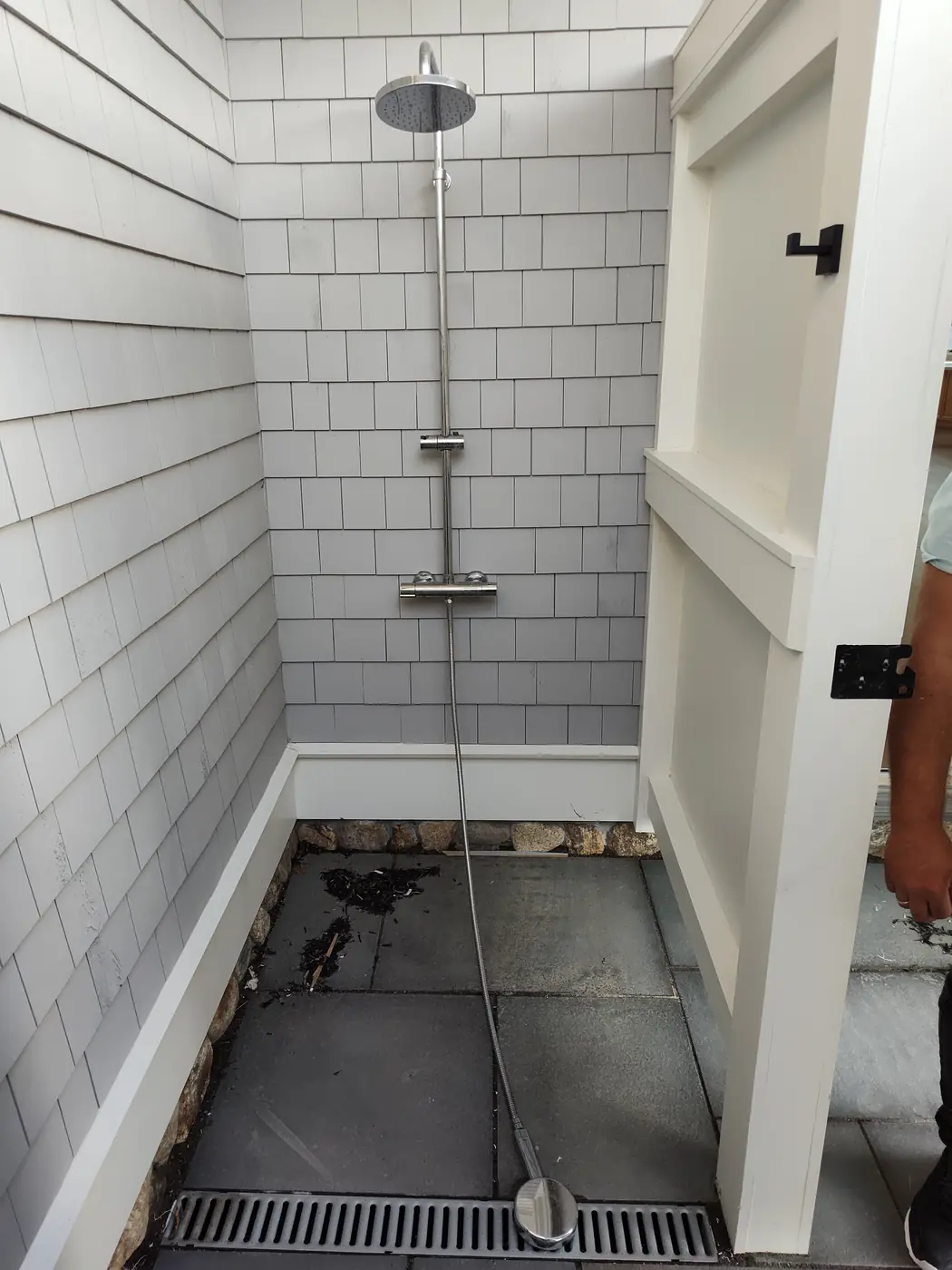
Outdoor showers are popular around here, and they freeze the same way hose bibs do, except they have hot and cold lines, a mixing valve and often a hand shower. To close one for the winter:
- Close the hot and cold shutoffs that feed the shower from inside the house.
- Open the shower valve fully, set to the middle between hot and cold, and leave it open.
- Open the drain-downs at the low point of the lines, if your shower has them, and let both lines empty.
- Take the hand shower and hose off and store them inside.
- Check the manufacturer's winter instructions for the valve. Thermostatic and pressure-balance cartridges can hold water even after the lines are drained, and some makers recommend taking the cartridge out for the winter.
A well-plumbed outdoor shower has its own shutoffs and drain valves inside heated space, so winterizing it takes a few minutes. If yours has to be drained by loosening fittings from a crawl space every fall, ask a plumber to add proper shutoffs.
Closing up a seasonal or vacant home
If a house, cottage or in-law unit will sit empty for the winter, it needs more than the outdoor fixtures done. The short version is in our frozen pipes guide. The full drain-down usually goes like this:
- Shut off the main water valve (and turn off the well pump, if you have one). Also ask your water department whether they want to shut the curb valve or pull the meter, because a frozen meter is often billed to the homeowner.
- Open every faucet, hot and cold, from the top floor down, and drain the system at its lowest point.
- Turn off and drain the water heater. Cut the power or set the gas valve to off or pilot first, as the manual says. Never run the heater with the tank empty.
- Flush the toilets and sponge out what's left in the tanks.
- Protect the traps. Pour non-toxic plumbing (RV) antifreeze, which is propylene glycol, into every sink, tub and shower drain and into each toilet bowl. Never use car antifreeze.
- Decide what happens to the heat. If the heat stays on, keep it at 55°F or higher and get the boiler serviced first. A hot-water heating system in a house that will be left unheated has to be either fully drained or filled with the correct glycol mix. That's a job for a professional.
Already found a split outdoor faucet or a leak inside the wall? Close the indoor shutoff (or the main water valve) right away and call. See our 24/7 emergency guide for the next steps.
Upgrades worth making this fall
If the same outdoor faucet freezes every few winters, or someone in the house always forgets to close the indoor valve, two upgrades take care of it. Replacing a standard hose bib with a frost-free sillcock of the right length means the shutoff happens inside the warm wall on its own. Adding a ball-valve shutoff with a drain on any outdoor line that doesn't have one makes winterizing a one-minute job. The cost mostly depends on how easy it is to reach the pipe from inside (a finished basement ceiling takes more work), how thick the wall is, what the pipe is made of, and what has to be done to the siding outside.
Frequently asked questions
When should I winterize my outdoor faucets in Massachusetts?
Before the first hard freeze. In most of Greater Boston, MetroWest and Worcester County that means late October to mid-November. One night in the mid-20s is enough to split an outdoor faucet that still has water in it, even while the pipes inside the house are fine.
Do I need to shut off the water to a frost-free outdoor faucet?
Usually not, if it's a true frost-free sillcock installed with a slight downward pitch to the outside. The one step you can't skip is disconnecting the hose. If you're not sure the faucet is frost-free and there's an indoor shutoff for it, close that valve too. It costs nothing.
Should I leave the outside faucet open or closed over the winter?
On a standard faucet, leave it open after you've closed the indoor shutoff and drained the line, so leftover water can drain out and any ice has room to expand. On a frost-free sillcock, close it as usual and keep the hose off.
How do I know if my outdoor faucet froze and cracked?
Most people find out in spring. The first time they turn on the hose, water runs inside the wall or drips from the basement ceiling. Have someone watch the basement near the faucet the first time you use it each year. If you see water, shut it off and call, because a split frost-free sillcock has to be replaced.
Do I need to blow out my sprinkler system?
If the system has buried lines and no reliable automatic drains, yes. A compressed-air blowout by an irrigation contractor is the standard way to clear the pipes. Either way, the backflow preventer on the outside wall has to be drained, because it's the part most likely to crack.
When to call a plumber
Call if an indoor shutoff won't close or keeps leaking, if your outdoor faucet has no shutoff at all, if you find water inside the wall the first time you use a hose, or if you'd like a seasonal home drained and winterized properly. We replace sillcocks, add shutoffs and drains, repair backflow preventers, and handle the indoor side of plumbing repairs across Greater Boston, MetroWest and Worcester County. If the heat goes out once the cold arrives, we handle boilers and water heaters too.
Want your outdoor faucets, shutoffs and backflow device checked before the first hard freeze? Call or request a quote.